eCommerce CRO Checklist
15 minutes
In the high-stakes world of digital retail, many eCommerce businesses focus on traffic acquisition, pouring vast budgets into SEO and PPC to fill the top of the funnel. However, the fastest revenue gains often come from Conversion Rate Optimization (CRO), one of the most effective ways to earn money without increasing advertising budgets.
Consider a classic scenario: Store A generates 50,000 monthly visitors with a 1% conversion rate. Store B has the exact same traffic but achieves a 2% conversion rate. As a result, Store B generates 2× the revenue without spending an extra cent on marketing. The overlooked truth is that most retail businesses ignore ecommerce CRO, leaking conversions at multiple friction points throughout the user journey. We’ve spent 10+ years mastering the art of ecommerce development—we know exactly where those leaks are and how to fix them. Moreover, we’re happy to share our experience with you and provide a practical framework for implementing effective CRO ecommerce strategies.
This guide explains what CRO means in practice, how to run meaningful tests, and how modern technologies—including AI—can accelerate optimization.
If your online store attracts thousands of visitors but only a small percentage completes a purchase, even modest improvements in conversion can drive significant revenue growth. If you agree with us, let's figure out how to achieve this, starting with the basics.
Conversion Rate Optimization (CRO) is the process of increasing the percentage of visitors who complete a desired action on a website, in our case, an online store. It’s mostly about improving how an online store works, how it communicates value, and how smoothly users can make a purchase.
In an ecommerce CRO context, a “conversion” may include:
The conversion rate itself is calculated using a simple formula:
Conversion rate = (Number of conversions ÷ Total visitors) × 100
An important nuance: conversions are more important than pure traffic, and here's why!
Many managers mistakenly believe that more traffic is the only way to scale, but focusing on ecommerce CRO often yields a much higher ROI. While marketing is an external expense that increases linearly, CRO is an internal efficiency gain that compounds over time.
As you can see, doubling the conversion rate doubles revenue from the same traffic. Still further, industry benchmarks highlight the potential for improvement too.
The average ecommerce conversion rate across industries is around 1.65–1.9%, according to 2026 benchmark studies.
At the same time, the largest revenue leak in online retail remains cart abandonment. Around 70% of online shopping carts are abandoned before checkout completion.
These numbers illustrate a key reality: most online stores already have enough traffic—they simply need better conversion performance.
A standard conversion funnel is a series of obstacles a customer must overcome to achieve their desired goal—purchase. Your goal is to reduce these obstacles, ideally to zero. That’s why it's so crucial to understand where conversion leaks occur.
Most online stores follow a similar purchase funnel:
Each step introduces potential friction. Typical drop-off points include:
Industry research shows that most stores lose most of the purchase intent before the final transaction: according to the latest data, cart abandonment rates average around 70% across eCommerce.
If you search for ecommerce CRO tips, you’ll find endless lists telling you to "change button colors", "use high-res photos", “add urgency messages”, or “simplify checkout”. And while these ideas can help, they are surface-level recommendations.
True CRO ecommerce success requires looking under the hood of your platform to ensure the code supports a frictionless experience:
Serious optimization always begins with a systematic audit.
There is no point in launching any experiments before you conduct a structured CRO audit. Many companies rush into A/B testing without understanding the real friction points in the user journey, and experiments often become random and ineffective. You must understand where you are to achieve real results.
An ecommerce CRO audit is a systematic evaluation of an online store to identify conversion barriers and find opportunities for improvement. To this end, you have to examine the entire buying journey from multiple perspectives and determine where conversions are being lost.
We advocate for a 4-layer CRO audit model to diagnose the health of your digital storefront:
Each layer addresses a different stage of the customer journey. Optimizing only one area, for example, improving product pages without addressing technical performance, rarely delivers strong results. Conversion optimization works best when you analyze the entire shopping experience.
Site speed and stability are the literal foundation of ecommerce CRO. If your online store is slow, your customers will leave before they even see your products and go straight to your competitors.
Large technology companies have studied this phenomenon extensively. Amazon famously reported that 100 milliseconds of additional latency could reduce revenue by roughly 1%, illustrating how sensitive users are to delays in digital environments.
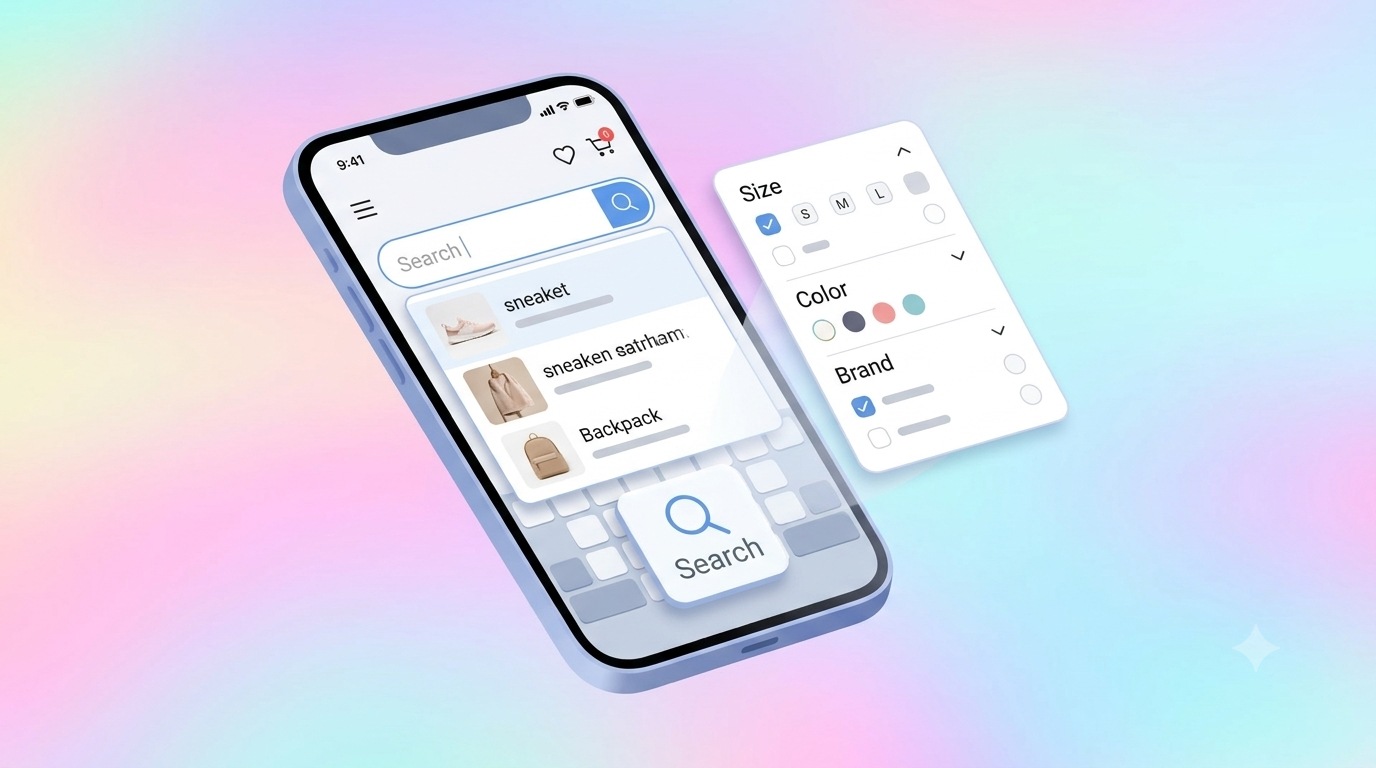
Baymard reports that 61% of sites have a poor search experience, leading to "no results" pages for simple queries. That should never happen to your visitors! The online shopping journey must be invisible—so intuitive that the user doesn't have to think. Don’t make customers feel lost while trying to give you their money.
The product page (PDP) is the "moment of truth," where the "Yes" or "No" happens. It often determine 80% of your conversion success. Salsify notes that 46% of consumers will leave a site if it lacks sufficient product information.
Simply put, this page must provide all the sensory information a user lacks, since they can't physically touch the product.
The checkout is the most sensitive part of your CRO ecommerce journey. The top reason for abandonment (48%) is extra costs, such as shipping and taxes, being too high or hidden until the end (Baymard).
Conducting a comprehensive audit of your online store against key ecommerce CRO metrics is only the first step. The real value lies in transforming raw data into actionable insights by answering three critical questions:
This leads to the most pivotal stage of the process: How exactly do we fix the issues we’ve found? The answer to that "how" is discovered through targeted experiments—what we call tactical tests.
Tactical CRO testing is the practical side of CRO ecommerce strategy: it translates analytical insights into measurable improvements.
Many online stores make the mistake of launching experiments randomly. They test visual changes on the homepage or modify colors and buttons without a clear hypothesis. While such tests occasionally produce small gains, they rarely generate meaningful improvements in conversion rates.
Effective ecommerce CRO programs focus on areas that directly influence purchase decisions. These typically include:
The following sections outline practical experiments, with eaach tactic addressing specific psychological or technical barriers to purchase.
When customers actively search for a product, they usually have a clear intention and are already evaluating options. For this reason, optimizing the search experience represents one of the most powerful opportunities within CRO ecommerce strategies.
However, many stores treat search as a basic utility rather than a conversion tool. Default search systems often return results based on simple keyword matching rather than relevance or commercial value.
For example, an electronics retailer might prioritize best-selling laptops or high-rated devices in search results for the query “gaming laptop.” This approach reduces decision friction and directs customers toward popular options that already perform well.
Also, try to experiment with "No Results Found" pages by adding "Recommended for You" sections instead of a blank screen.
Category pages serve as the bridge between discovery and decision-making. Customers who arrive here typically want to compare multiple products before committing to a purchase.
Despite their importance, category pages are often designed as simple product grids with little guidance or context.
If you use social proof as a guiding force (for instance, sort products by "Top Rated" by default), you reduce cognitive overload. When customers receive clear signals about product popularity or value, they can narrow their choices faster and move more confidently toward checkout.
Product pages are where purchase decisions ultimately occur. Even if marketing campaigns bring visitors to the site and navigation helps them locate products, the final decision usually happens on the product page itself.
The role of ecommerce CRO here is to replace uncertainty with actionable data. By optimizing the smallest interface details—the touchpoints that influence micro-conversions like viewing gallery images, expanding product details, or triggering 'Add to Cart'—you create the momentum necessary to guide customers toward the final transaction.
For instance, a simple notification such as “Only 7 items left in stock” can introduce urgency and motivate customers to act sooner. Similarly, displaying delivery estimates helps eliminate uncertainty about shipping time, which is often a major factor in purchase hesitation.
Although these elements appear small, together they shape the overall purchase experience and strongly influence CRO ecommerce performance.
In CRO ecommerce optimization, pricing experiments aim to reduce psychological barriers that prevent customers from completing purchases. For higher-priced products in particular, breaking down costs into smaller installments can significantly increase purchase willingness.
You can compare a "Free Shipping" offer against a "10% Discount" offer. Frequently, free shipping converts better even when the discount amount is higher.
For example:
The checkout process represents the final and most critical step in the purchase journey. By the time a customer reaches checkout, they have already invested time exploring the store and selecting products. Any friction at this stage can cause frustration.
Industry research consistently shows that checkout complexity is a major driver of cart abandonment. Long forms, mandatory account creation, or unclear payment options often interrupt the buying momentum.
Mobile traffic often represents 70–80% of visits, yet mobile conversions remain lower. Make sure you don't make the same mistake as many ecommerce business owners who miss out on customers who prefer to buy via mobile devices.
Some stores report 10–20% increases in conversion from sticky mobile purchase buttons alone.
.png)
The moment immediately after checkout is one of the most underutilized opportunities in eCommerce. At this stage, customers have already demonstrated trust in the store and completed a transaction. So that’s the best time to strengthen customer relationships and encourage future purchases.
For example, offering 10% off the next order immediately after checkout can motivate customers to return sooner, effectively increasing lifetime value.
Not all visitors behave the same way. New users, returning customers, and loyal buyers often have very different motivations and expectations. Instead of presenting identical content to every visitor, you have to dynamically adjust the store’s interface and offers.
These experiences make the store feel more relevant to each customer, which can significantly improve engagement and CRO ecommerce performance.
Behavioral triggers allow stores to respond to user actions in real time. By monitoring visitor behavior, the system can deliver targeted messages when specific patterns appear.
For example, if a user repeatedly views a product but hesitates to purchase, the store can present additional incentives or helpful information.
These automated sequences often recover a meaningful portion of otherwise lost sales.
Content marketing is rarely viewed through the lens of CRO, yet it is essential for driving informed customer decisions. Thoughtfully crafted educational material resolves uncertainty, equipping shoppers with the information they need to commit to a purchase with confidence.
For instance, an article titled “Best Running Shoes for Flat Feet” can attract organic traffic while simultaneously guiding readers toward specific product recommendations.
Effective ecommerce CRO is a bridge between consumer psychology and technical execution. Identifying a drop-off in the conversion funnel is a marketing function, but resolving it often demands a developer’s touch—whether that’s refactoring a slow-loading product grid or optimizing mobile responsiveness.
Examples include:
Without a dedicated technical backbone, even the most brilliant marketing insights remain nothing more than unrealized hypotheses. This is especially critical for complex architectures like Magento and Shopify, where off-the-shelf solutions often hit a ceiling.
At Laconica, we bring over 15 years of deep-tier development expertise to the table. Serving a global clientele, we specialize in moving beyond the limitations of standard plugins to engineer high-performance improvements that transform ambitious CRO strategies into measurable bottom-line results.
CRO ecommerce optimization should become an ongoing process rather than a one-time project. Instead of implementing occasional design changes, you have to develop structured experimentation programs that continuously improve the store experience.
We invite you to take a look at the practical ecommerce CRO workflow: see how we do it at Laconica.
A detailed audit identifies performance bottlenecks, UX issues, and behavioral patterns that limit conversions. This step combines analytics data, user behavior insights, and technical analysis.
Once the audit is complete, the next step is to discover the most critical obstacles preventing users from converting.
These friction points may include:
Each issue becomes a potential testing opportunity.
Not all improvements produce the same impact. A structured CRO program prioritizes experiments based on potential business value.
Examples of high-impact areas:
At this stage, experts test specific hypotheses through controlled experiments. Two or more page variations are shown to different user segments, allowing analysts to measure which version performs better.
A/B testing provides the statistical evidence needed to determine whether a change genuinely improves CRO ecommerce performance.
Once sufficient data is collected, the winning variation can be implemented across the store. However, the process doesn’t stop here.
Each experiment generates insights that inform future testing ideas, gradually building a deeper understanding of customer behavior.
Leading eCommerce companies maintain a CRO backlog, a structured list of testing ideas and improvement opportunities.
These ideas are continuously evaluated and prioritized based on potential impact and implementation complexity.
Conversion optimization is never finished. As customer expectations evolve and product catalogs grow, new friction points emerge.
By repeating the audit–test–learn cycle, businesses create a sustainable system for continuous improvement.
In many organizations, these programs are implemented collaboratively between marketing teams, data analysts, and development partners who can translate insights into technical improvements across the store infrastructure.
Artificial intelligence is becoming increasingly influential in modern CRO ecommerce strategies. While traditional optimization relies heavily on manual analysis and hypothesis-driven testing, AI tools can uncover behavioral patterns that might otherwise remain hidden.
AI is capable of analyzing thousands of data points—such as mouse movement, time on page, and referral source—to predict whether a user is likely to bounce. It can then trigger a real-time "Intent-Based Offer," such as a personalized discount code, only for the users it identifies as "high-risk." This prevents you from giving discounts to people who would have bought anyway, protecting your margins.
In the past, testing 50 different product descriptions was impossible. With AI, you can generate and test hundreds of variations of headlines and calls-to-action (CTAs) simultaneously. AI tools learn which tone of voice resonates with specific demographics and automatically serve the best-performing copy to that specific user segment.
Traditional A/B testing splits traffic 50/50 and waits weeks for a winner. AI-powered "Multi-Armed Bandit" testing identifies the winning version in real time and starts shifting traffic to it immediately. This minimizes the "loss" incurred by showing the underperforming version to users during the test period.
Another promising area is personalization. AI-driven recommendation engines can analyze past purchases, browsing history, and contextual signals to deliver tailored product suggestions for each visitor.
This capability transforms the shopping experience from a static catalog into a dynamic environment that adapts to individual user preferences. Over time, these systems continuously improve as they collect more behavioral data.
While AI tools cannot replace human expertise in ecommerce CRO, they significantly enhance the speed and scale of experimentation. Businesses that combine data-driven testing with intelligent automation are more likely to gain a competitive advantage as eCommerce leaders.
CRO ecommerce is the most effective lever for increasing profitability because it focuses on unlocking hidden revenue in existing traffic. While most stores only optimize superficially—tweaking a color or a font—the companies that systematically outperform their competitors treat optimization as a core business process.
Successful ecommerce CRO requires a blend of data analysis, behavioral psychology, and high-end software engineering. Partnering with experienced developers like Laconica enables businesses to implement deep technical CRO improvements—such as backend speed optimization and custom checkout logic—that marketing tools alone cannot deliver.
Are you ready to stop losing sales to friction? Contact Laconica today for a technical audit of your storefront.
A good eCommerce conversion rate typically falls between 1% and 4%, though this varies by industry. According to IRP Commerce, the average for food and drink is 3.5%, while furniture sits at 0.5%. In summary, you should benchmark against your own historical data and industry-specific averages.
The most critical factors are site speed, product page quality, trust signals, and checkout simplicity. A Deloitte study found that a 0.1s improvement in mobile speed led to an 8.4% increase in conversion. If your site takes longer than 3 seconds to load, you’ve already lost a huge chunk of your audience.
Other heavy hitters include:
A typical CRO test takes 2-4 weeks to reach statistical significance. You generally need at least 250-500 conversions per variation to be sure the result isn't just a fluke.
The duration depends on your traffic volume; high-traffic stores can find winners in days, while smaller stores might need a full month. In summary, you must wait for enough data to ensure your changes are actually driving more revenue.
The essential toolkit for CRO includes Google Analytics 4, heatmapping software like Hotjar, and A/B testing platforms like VWO or Optimizely.
You know your store needs to implement CRO ecommerce strategies if your bounce rate is over 50% or your cart abandonment rate is over 70%. If you are spending more on ads but your revenue is staying flat, it's a clear sign that your funnel is broken. Other red flags include low time-on-page and high exit rates on your checkout page.
Yes—even small improvements in conversion rate compound quickly to create massive revenue growth. For a small business, increasing the conversion rate from 1% to 1.5% is the same as getting 50% more traffic for free.
Because small stores have smaller ad budgets, they can't afford to waste traffic. Every visitor counts. In summary, CRO is the most cost-effective way for small brands to compete with larger retailers.

Written by:
Co-founder / CEO, Laconica
Volodymyr co-founded Laconica in 2014 after seven years as a UI/UX designer for global brands. Since then he has led 100+ Magento and Shopify projects, from migrations to AI visibility and CRO. He writes about what actually moves revenue for online stores, based on client work, not theory.

Reviewed by:
Co-founder / CTO, Laconica
Anna reviews every article on this blog for technical accuracy before it goes live. She has 20 years in software engineering, 15 of them in Magento and eCommerce. Before Laconica she was a C# developer and team lead at large enterprise companies. As CTO she leads the engineering team and oversees Magento 2, Hyvä and Shopify architecture on every client project. If a number or a code claim is in the article, she has checked it.