London Tech Week 2026
10 minutes
Over the past few years, the race to adopt AI has dominated discussions in boardrooms and events of all scales. Companies rushed to experiment with innovative tools, launch AI pilots, and identify new automation opportunities. It seemed the faster you implemented AI, the greater your competitive advantage. And so it was, for a time.
Now, the initial euphoria of "plug-and-play AI" has officially ended, as recent events in the heart of the UK have confirmed.
At London Tech Week and The AI Summit London 2026, one message surfaced repeatedly across keynotes, panel discussions, and C-level conversations: the speed of AI adoption isn’t the biggest challenge anymore. Instead, boardroom doors are closing around a much more urgent problem: “Who is controlling the AI inside our company right now?”
Luckily, we can share with you exactly what was discussed at these London events. Whether you're running a fast-growing business, scaling a digital platform, or leading a large retail ecosystem, this behind-the-scenes insight will help you create an effective strategic roadmap for the rest of 2026.
At Laconica, we regularly attend global tech events to keep an eye on emerging trends and understand how business priorities evolve. To stay ahead of the curve and ensure our clients always get future-proof, scalable software, we’ve spent a week at London Tech Week and The AI Summit London.
These recent events brought together technology executives, enterprise architects, AI practitioners, and business leaders from around the world. And while we expected to hear discussions about the latest models and capabilities, the most valuable insights came from a different direction. Businesses are no longer asking whether AI can create value. They are asking how to manage growing AI ecosystems, reduce AI security risks, establish effective AI governance frameworks, and ensure that rapid AI implementation doesn't create long-term operational challenges.
In other words, organizations are moving from AI experimentation to AI accountability.
One of the most discussed topics at both events was the growing gap between AI adoption and organizational oversight.
The problem is simple: every department wants to move faster. Marketing teams use AI to generate content. Customer service teams deploy AI assistants. Operations teams automate workflows. Developers integrate AI-powered automation into internal systems. Individual employees create their own productivity tools using generative AI.
Each initiative may deliver value on its own. Together, however, they become increasingly difficult to monitor and govern, creating a brand-new set of organizational headaches:
This phenomenon is commonly referred to as Shadow AI, which has replaced Shadow IT, when employees use unauthorized SaaS tools to speed up their workflows.
What makes Shadow AI particularly challenging is that it rarely appears because employees are acting irresponsibly. In most cases, people are simply trying to solve business problems faster than existing processes allow.
The result is a growing network of autonomous AI agents, AI-powered workflows, and digital assistants operating with limited visibility and inconsistent oversight.
As an entrepreneur and AI leader, Manoj Saxena noted during the event:
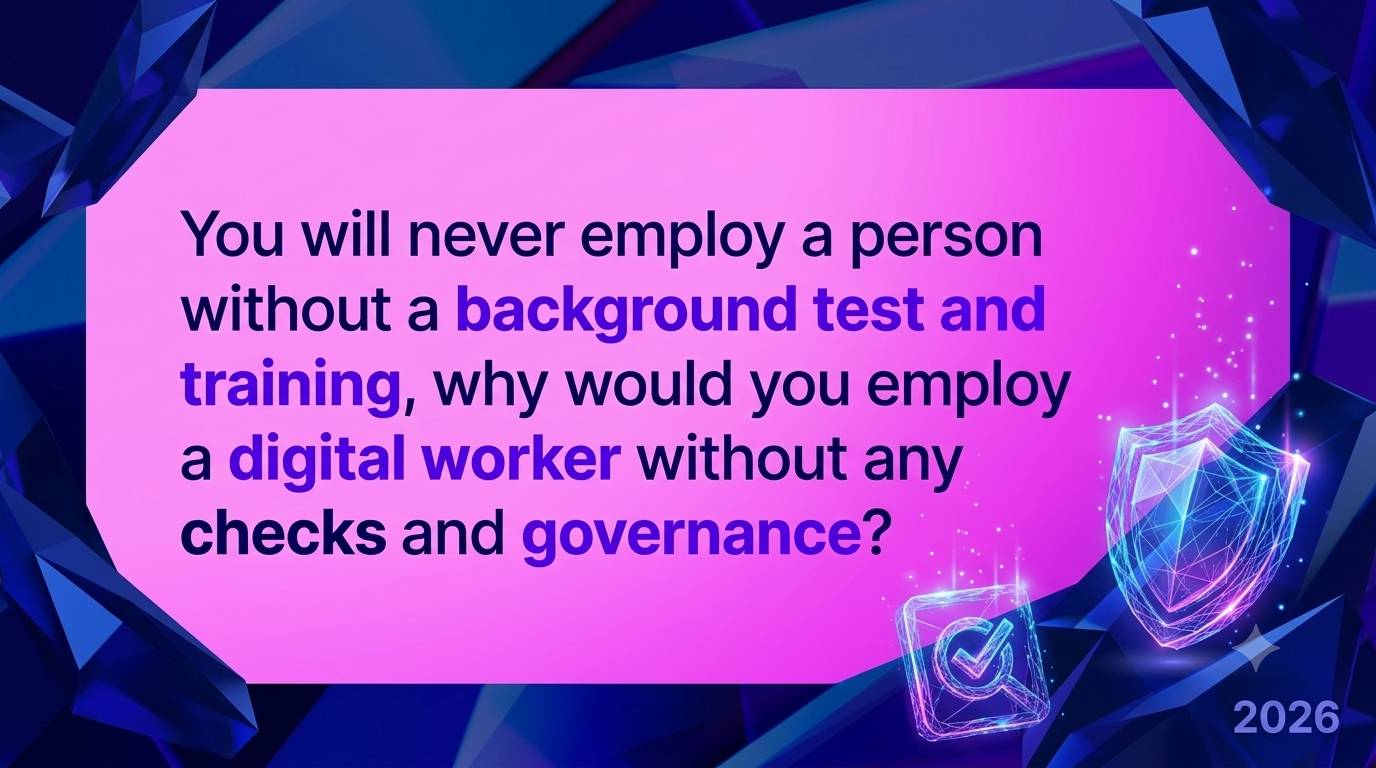
This comparison resonates because organizations are assigning AI systems the tasks previously performed by human employees. However, there is still no clear approach to corporate enterprise AI governance, AI risk management, and proper monitoring.
It’s time to make a change!
Nowhere is this crisis more acute than in the digital retail sector. AI integration in e-commerce has moved past simple recommendation widgets. Today, it drives everything from dynamic pricing engines and AI-powered personalization to automated customer return workflows and inventory forecasting.
Sure, these capabilities help e-commerce increase both efficiency and conversions, but they also raise the stakes. A single AI-powered workflow rarely operates in a vacuum. Instead, it routinely taps into the very lifeblood of your digital storefront, holding simultaneous access to three critical pillars of your business:
In other words, when e-commerce AI automation is deployed as "Shadow AI," the finances and reputation are at risk:
These are not theoretical concerns. They are becoming practical business questions for organizations pursuing an ambitious e-commerce AI strategy.
While governance dominated many conversations in London, another insight stood out for a very different reason. It’s about a philosophical yet deeply practical boundary that must be drawn regarding the actual role of AI.
During a standout session, Sanjana Nagesh (from WPP Productions / Hex) highlighted a critical truth about human-AI collaboration: AI represents our hands, not our brains. The industry is beginning to forget that AI is a producer, not a creator.
According to Nagesh, the core strengths and limitations of AI break down into distinct categories:
When businesses treat AI as the architect of their strategy rather than a worker executing tasks, the resulting systems lack direction, logic, and long-term viability. The organizations creating the most value from AI are taking a different approach. They use AI to accelerate delivery while relying on people to make decisions and define priorities.
Long story short, you are the leader with the vision—AI is just the tool bringing it to life. It only follows your instructions and implements your narrative.
This is also true for technology. AI is ready to work for you, but it should never be left to run the company on its own. Only highly customized, secure AI ecosystems for business can protect the entire transactional pipeline and help the company scale safely.
The only way to achieve this is to move away from fragmented plugins and put the right architects in charge of the build. And we, the Laconica team, can take on the role of such architects.
.png)
E-commerce businesses are actively implementing AI into their processes, and rightly so. Moreover, we eagerly assist them in this endeavor as an experienced tech partner.
To maximize the ROI of your digital transformation without compromising security, our team follows a rigorous, architect-led deployment framework:
Whether you are looking to secure high-volume checkout flows, stabilize an enterprise-grade e-commerce platform, or bulletproof your supply chain workflows, Laconica delivers the specialized engineering expertise to keep your systems resilient, compliant, and ready to scale.
Stop guessing who controls the AI inside your platform. Contact Laconica today to secure your digital retail ecosystem. Schedule a session with our Lead Architects and map out a bulletproof, compliant roadmap for 2026.

Written by:
Co-founder / CEO, Laconica
Volodymyr co-founded Laconica in 2014 after seven years as a UI/UX designer for global brands. Since then he has led 100+ Magento and Shopify projects, from migrations to AI visibility and CRO. He writes about what actually moves revenue for online stores, based on client work, not theory.

Reviewed by:
Co-founder / CTO, Laconica
Anna reviews every article on this blog for technical accuracy before it goes live. She has 20 years in software engineering, 15 of them in Magento and eCommerce. Before Laconica she was a C# developer and team lead at large enterprise companies. As CTO she leads the engineering team and oversees Magento 2, Hyvä and Shopify architecture on every client project. If a number or a code claim is in the article, she has checked it.