Microservices for eCommerce
15 minutes
Global eCommerce retail sales continue to grow year by year, accounting for nearly 20.5% of the total by the end of 2025. And that's not the limit! Moreover, modern consumers have become more demanding, expecting fast, personalized experiences across devices, channels, and markets. In response, eCommerce platforms must be agile, resilient, and deeply integrated with AI, analytics, and third-party systems—and microservices architecture enables exactly that and even more.
If your online store is still running an outdated, unsuitable system, consider yourself outmatched by your more forward-thinking competitors. Traditional, rigid infrastructure can no longer keep pace with the market, losing out to ecommerce microservices architecture across the board.
At Laconica, we have been helping ecommerce businesses move past these legacy failures for over 15 years. Our mission is to provide the architectural clarity needed to evolve confidently—whether you are optimizing a Magento store or scaling a custom enterprise platform.
To help you understand microservices and why they're so trendy in online retail, we’ve prepared this special guide. We've tried to make it not only theoretically valuable but also practically applicable, so you'll find many actionable, ready-to-use tips.
In this guide, you’ll discover:
Picture this: on Black Friday, a mid-sized retailer watches in horror as their customer traffic doubles in just 10 minutes. The fear is natural, as their online store is based on a legacy monolithic system that processes everything, from the product catalog to the checkout, in a single "block" of code. Any bottleneck would cause the site to freeze. And in 2026, the average hourly cost of downtime for retail and ecommerce can reach $1.1 million. For billion-dollar enterprises, that figure may escalate to $23,750 per minute.
That's why, as analysts report, 74 % of enterprises have already pivoted to an ecommerce microservice architecture. This model distributes responsibility, improves flexibility, scales horizontally, and allows teams to innovate fast—all key capabilities for flourishing in 2026.
If you're unsure what's right for your online store, read our article on picking the right e-commerce architecture. We'll help you make the right choice!
eCommerce microservices architecture is a modern software design pattern where a single large application is broken down into a collection of small, self-contained components—so-called services. These services interact via APIs and can be developed, deployed, and scaled separately without affecting the rest of the system.
Instead of one giant codebase (monolith), each service focuses on a specific part of the business:
This approach mirrors real business domains and supports the independent evolution of each capability, thereby saving the business its most valuable resources - time and money.
To understand why this is the gold standard for 2026, we must compare it to the alternatives.
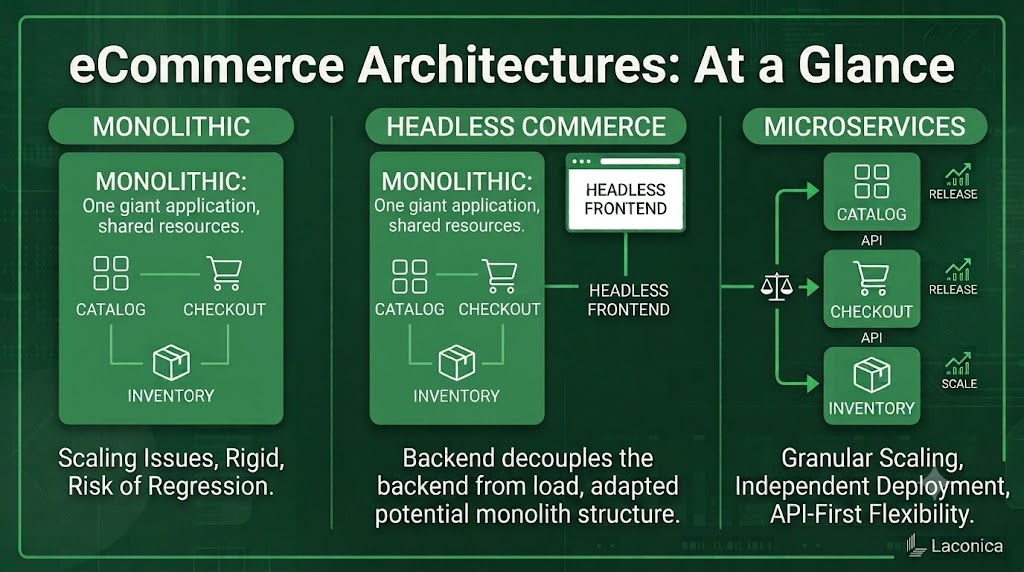
Monolithic Architecture: A single, unified unit where all code is interconnected. A bug in the "Reviews" section can take down the entire checkout process.
Headless Commerce: A strategy that decouples the front end from the back-end logic, but can still be monolithic inside.
By the way, today, many top online retailers combine headless commerce with microservices architecture for ecommerce. They use APIs and event streams to connect independent services to modern front ends across channels.
An ecommerce microservice architecture relies on several moving parts working in harmony:
Microservices didn’t arrive in a vacuum. They evolved from early distributed computing experiments at tech giants like Amazon and Netflix.
The "seasonality factor greatly contributed to the adoption of this technology into eCommerce. The thing is, retailers require significant capacity during the holidays (5-10% of the year), when user traffic peaks, and only a fraction of power during the rest of the year.
The main benefits of ecommerce microservices architecture include independent scalability, isolated risk, faster development cycles, and seamless integrations—all crucial for performance, growth, and competitive advantage.
Now let's discuss these (and many other) points one by one and in more detail.
During Black Friday, traffic can suddenly spike 10x or 20x. Microservices allow you to scale only the "Checkout" service to handle this load, rather than wasting resources scaling the entire application.
Teams can release changes in one service without redeploying the whole system, shortening time to value and enabling experimentation.
Incidentally, faster innovation is the very reason why 60% of enterprises implemented ecommerce microservice architecture. At least, that's what analysts report: companies adopt this technology specifically to speed up the time it takes to bring products and services to market.
You can modernize outdated systems piece by piece. By the way, Laconica’s modernization services specialize in this gradual evolution, ensuring your store performs exactly as your business requires without a total "rip and replace".
Microservices support global expansion with native multi-currency and localization features, essential as the Asia Pacific region now accounts for over 54% of global ecommerce revenue.
Each service can use the best technology for its task (e.g., different languages and databases), enabling specialization without constraints.
Microservices connect seamlessly with external tools—such as AI engines, analytics platforms, and ERP/CRM systems—without creating tight coupling.
Of course, every project is unique, and we can’t recommend a universal tech stack that fits any requirements. However, we would highlight some basic and typical modules that a modern microservices architecture (ecommerce) usually includes:
While microservices are an architectural style, MACH (Microservices, API-first, Cloud-native, Headless) is a philosophy. Most modern microservices setups strive to be "MACH compliant" to avoid vendor lock-in. That’s the very reason why, according to recent research, about 87 % of companies now use MACH architectures.
As we've said before, these are just basic rules that need to be adapted to your specific project. And an experienced partner like Laconica will help tailor the architecture to your business needs.
While microservices offer numerous advantages, this architecture type isn't a must for everyone. In some cases, simpler options would do much better.
Let's find out which category your business falls into.
Microservices are best for mid-to-large online stores with high expectations for growth, experimentation, and performance under variable load.
To be precise, ecommerce microservice architecture is a strategic investment for:
So if you deal with:
then go for it!
For early-stage startups or businesses with stable, predictable traffic, a pre-built CMS like Shopify might be more cost-effective due to its lower initial investment and faster setup time.
By the way, our team has extensive experience in Shopify ecommerce development and would be happy to support you.
In such cases, a modular monolith or headless strategy may serve better until scale justifies microservices.
If you want to better understand which platform is ideal for your online store, check out our article that compares custom eCommerce Development and a pre-built CMS approach.
The most successful migrations use the Strangler Fig Pattern, which gradually replaces monolithic functions with microservices.
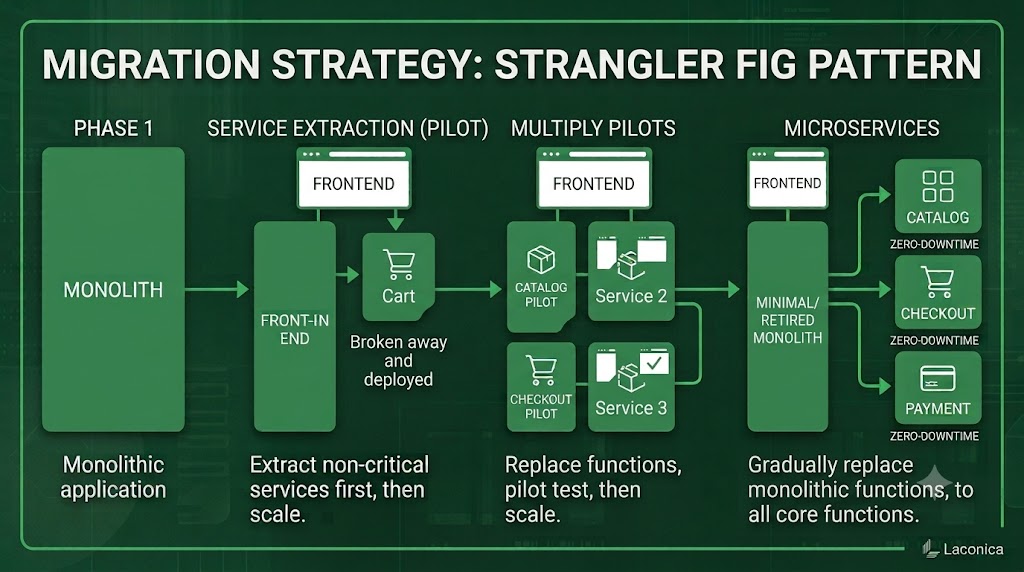
At Laconica, we ensure continuous operation by automating deployment, monitoring, and rollback/forward strategies.
You won't be surprised to learn that today the ecommerce landscape has shifted from "mobile-first" to "AI-native. AI isn't an add-on feature: it’s integrated through APIs and event streams, and microservices excel at this.
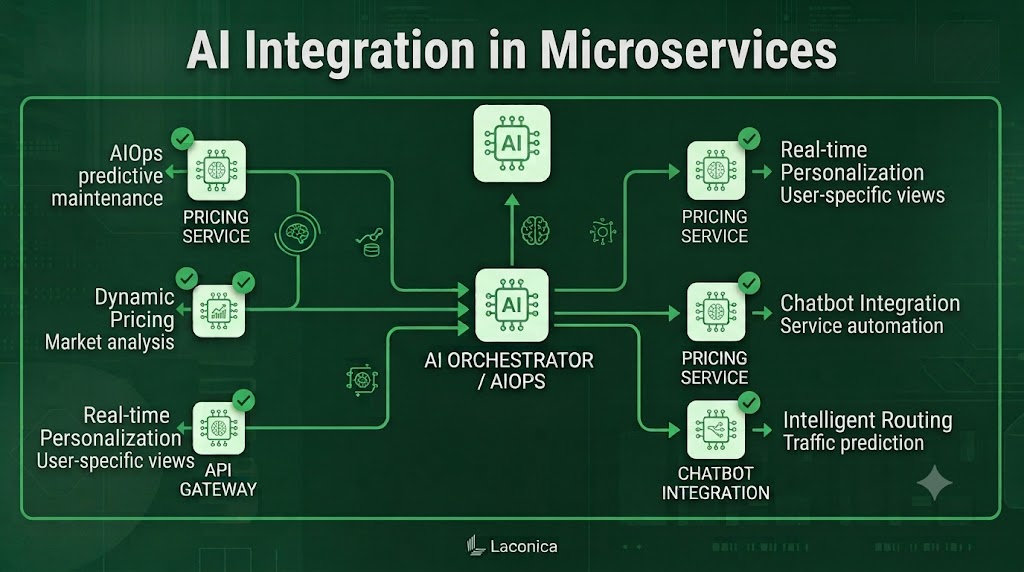
Possibilities of an AI-enhanced microservices architecture for ecommerce:
eCommerce microservices architecture is a design pattern where an online store is built as a series of small, independent services that communicate via APIs. Each service handles a specific business task (like payments or inventory). In summary, it allows parts of your store to be updated or scaled independently, preventing the "entire site crash" common with older monolithic systems.
Headless commerce focuses on separating the front end (design) from the back end (logic), while microservices focus on breaking that back-end logic into smaller, independent services. Many brands use them together; for example, our Laconica often pairs Hyvä Themes (the front-end) with a modular back end for maximum performance.
Initial microservices adoption is typically more expensive than a monolithic change, but ROI emerges from reduced downtime, faster launches, lower scaling costs, and better integration with AI and marketing stacks. Statistics show that 90% of retailers migrating to composable and microservices platforms see revenue and sales increases over time.
Not automatically. While they allow for unlimited scaling during traffic spikes, they introduce "network overhead" because services must talk to each other. However, 28% of companies report that improved application performance is a key benefit they achieved after adoption.
In short, microservices provide the capacity for superior performance, but require professional optimization to reach it.
A full enterprise migration can take 3 to 6 months for a pilot phase, but the transition often spans 12+ months as part of a long-term strategy. By using a hybrid model, businesses can balance speed and flexibility, starting to see results quickly without waiting for a total rebuild. In summary, it is an incremental journey rather than a single event.
The initial setup cost is typically "Moderate to High" because it requires more infrastructure and expert engineering compared to a basic CMS. However, 87% of companies state that the adoption expenses are worth it due to the long-term savings in scalability and reduced downtime. So, you invest more upfront to avoid the massive revenue losses caused by legacy bottlenecks.
Adopting an ecommerce microservices architecture is the definitive move for brands that refuse to be slowed down by legacy tech. By 2026, the question is no longer if you should move toward modularity, but how fast you can do it to support the new era of AI-driven commerce.
While the transition requires a shift in both tech and team culture, the rewards—limitless scalability, faster releases, and a future-proof foundation—are the keys to winning the next decade of retail.
Ready to evolve? Partner with Laconica for the strategic planning, implementation, and long-term support. We can start by conducting a performance audit of your current platform to see if it's ready for a microservices transition.

Written by:
Co-founder / CEO, Laconica
Volodymyr co-founded Laconica in 2014 after seven years as a UI/UX designer for global brands. Since then he has led 100+ Magento and Shopify projects, from migrations to AI visibility and CRO. He writes about what actually moves revenue for online stores, based on client work, not theory.

Reviewed by:
Co-founder / CTO, Laconica
Anna reviews every article on this blog for technical accuracy before it goes live. She has 20 years in software engineering, 15 of them in Magento and eCommerce. Before Laconica she was a C# developer and team lead at large enterprise companies. As CTO she leads the engineering team and oversees Magento 2, Hyvä and Shopify architecture on every client project. If a number or a code claim is in the article, she has checked it.