eCommerce Architecture
14 minutes read
Today, ecommerce architecture matters more than ever, going beyond platform choice and becoming a strategic driver of your expansion and revenue. Every feature you launch, every personalized experience you offer, and every new market you enter relies on how well your systems are designed. Poor architecture can silently constrain growth, increase costs, and frustrate both customers and internal teams.
Companies that embrace modern ecommerce architecture are better equipped to handle seasonal spikes, support omnichannel initiatives, and integrate with third-party systems. They can innovate rapidly without causing downtime or technical debt.
If you want to join the ranks of such forward-thinking companies, we encourage you to explore our new piece. Based on our hands-on experience, it provides valuable insights into choosing an effective architecture and offers practical, actionable tips.
This guide is designed for ecommerce owners, managers, and decision-makers. By the end, you’ll understand:
Ecommerce architecture is the structural design of an online commerce system. It determines how front-end experiences, backend commerce logic, integrations, and infrastructure work together to deliver seamless shopping experiences and operational efficiency.
What does your online store's architecture have to do with all this? It's actually quite simple!
At its core, ecommerce architecture answers questions like:
Modern ecommerce architecture is built to be modular, decoupled, and API-first. It allows businesses to grow continuously, integrate new services, and experiment with user experiences—all without breaking core systems.
Later on, we'll go into more detail about all these benefits. For now, we'll list them briefly so you understand from the start how important it is to think through the architecture of your ecommerce business.
Tip from Laconica: When designing modern ecommerce architecture, decouple user-facing experiences from backend commerce logic. This way, your marketing, product, and engineering teams can iterate simultaneously without friction.
Let’s discuss the main types of architecture used today: Monolithic, Modular, Microservices, Headless, Composable, and Custom. Each comes with unique advantages, challenges, and suitability for different business models.
Monolithic architecture relies on tightly interconnected components—frontend, backend, database, and integrations—within a single system. As the standard for early ecommerce platforms, this architecture type is gradually losing relevance today, though it is still used in many legacy solutions.
A small online retailer using a monolithic system may find it easy to manage a single website with standard checkout. However, launching a mobile app or an international storefront requires significant redevelopment.
If your business is still on a monolithic system, consider incremental modernization with headless or composable elements to avoid disruptive replatforming. This allows you to maintain stability while increasing agility.
Modular architecture separates functionality into discrete modules, e.g., catalog, checkout, CMS, and payment, all operating within a shared platform. This approach is beneficial in many ways, including maintainability. Moreover, you can work on individual store elements and perform selective upgrades without impacting the entire system or disrupting other ecommerce operations.
A mid-size retailer using a modular system can upgrade its search functionality without touching checkout or inventory logic, enabling a better customer experience with minimal disruption.
Modular systems are a practical first step toward modern ecommerce architecture, especially for businesses that need some flexibility without committing to full headless or composable setups.
Microservices architecture breaks an ecommerce platform into fully independent services (applications), each responsible for a single function (inventory, checkout, pricing, CMS, personalization, etc.). These services communicate through APIs or event streams and are less dependent on the core system.
Unlike modular solutions, where all modules operate within a single system and usually share the same backend, microservices are more flexible, each with its own database and deployment pipeline.
A global B2B marketplace with hundreds of vendors used a microservices architecture for its platform. Therefore, they could add new features to a single service without touching the rest of the system. As a result, during peak sales periods, the company scaled only the checkout module to handle traffic, improving performance and avoiding downtime.
We recommend that companies implementing microservices carefully design service boundaries and APIs and implement monitoring to ensure reliability and scalability.
Headless architecture decouples the frontend (customer-facing interface) from backend commerce logic. The frontend communicates with the backend through APIs, enabling teams to create rich, personalized experiences without affecting core systems.
A DTC brand wants to experiment with a Progressive Web App (PWA) for mobile users. Using a headless architecture, they can deploy the PWA independently from the backend commerce engine, allowing faster iteration and performance optimization.
If you'd like to delve even deeper into this topic, check out our new article about headless eCommerce architecture.
Composable architecture extends headless principles by allowing companies to assemble best-of-breed business capabilities, connected via APIs, into a unified system. These capabilities, often called PBCs (Packaged Business Capabilities), can be independently upgraded or replaced.
This approach has some similarities with microservices, although they are not actually the same thing. Composable commerce is a more business-driven architectural strategy that may (but doesn’t have to) use microservices. Besides them, you can build a composable platform using SaaS APIs, modular solutions, or even headless systems.
Simply put, you compose your platform rather than buying an all-in-one system.
Composable commerce is ideal for businesses seeking modern ecommerce architecture that scales globally.
And of course, we shouldn't forget about custom architecture, which is focused on unique projects and atypical business flows—those that more conventional approaches can't fully satisfy. This approach often combines off-the-shelf products with proprietary services and specialized integrations.
A B2B marketplace with tiered pricing, multi-vendor operations, and regional compliance requirements may require a custom architecture to efficiently manage these complexities.
Custom architectures should be approached strategically. Laconica experts work with businesses to design scalable, maintainable systems that align with both current operations and long-term growth objectives.
We've already explained how ecommerce architecture impacts your business; now it's time to go over the benefits in more detail.
Performance means speed, and speed means revenue and your profit. A fast, responsive system keeps customers engaged and reduces cart abandonment. Conversely, a slow system erodes trust and limits sales.
Statistical data confirms our words: ecommerce websites with close to 1-second load times can have 3× higher conversion rates than resources loading in 5 seconds.
Monolithic systems can become sluggish as traffic and integrations grow. Headless, microservices, and composable architectures don't have these issues, enabling independent scaling of modules such as checkout, search, and recommendations. This approach preserves performance during peak demand, which is especially crucial for hot holiday seasons.
A headless DTC fashion brand handled a 3x traffic spike during a social media campaign without downtime or slow checkout, maintaining a 1.2% higher conversion than competitors with monolithic systems.
Modern ecommerce architecture ensures rapid experimentation and feature deployment. Business teams can test personalization, run promotions, and launch new storefronts without waiting for backend adjustments.
A brand using a headless or composable architecture can introduce a new payment provider or loyalty program in weeks instead of months.
Businesses with monolithic architecture, on the other hand, often face release cycles of 3–6 months for even minor updates.
Investing in modern ecommerce architecture may increase initial costs but significantly lowers long-term maintenance and operational friction.
Scalability is essential for growing businesses, especially during peak periods like Black Friday or new product launches. That's where modern eCommerce architectures can really help: the right foundation for your online store ensures confident growth, avoids technical debts, and doesn't interfere with daily business operations.
Headless, microservices, and composable systems allow horizontal scaling: for example, adding more server resources to checkout independently from product catalog or content management systems.
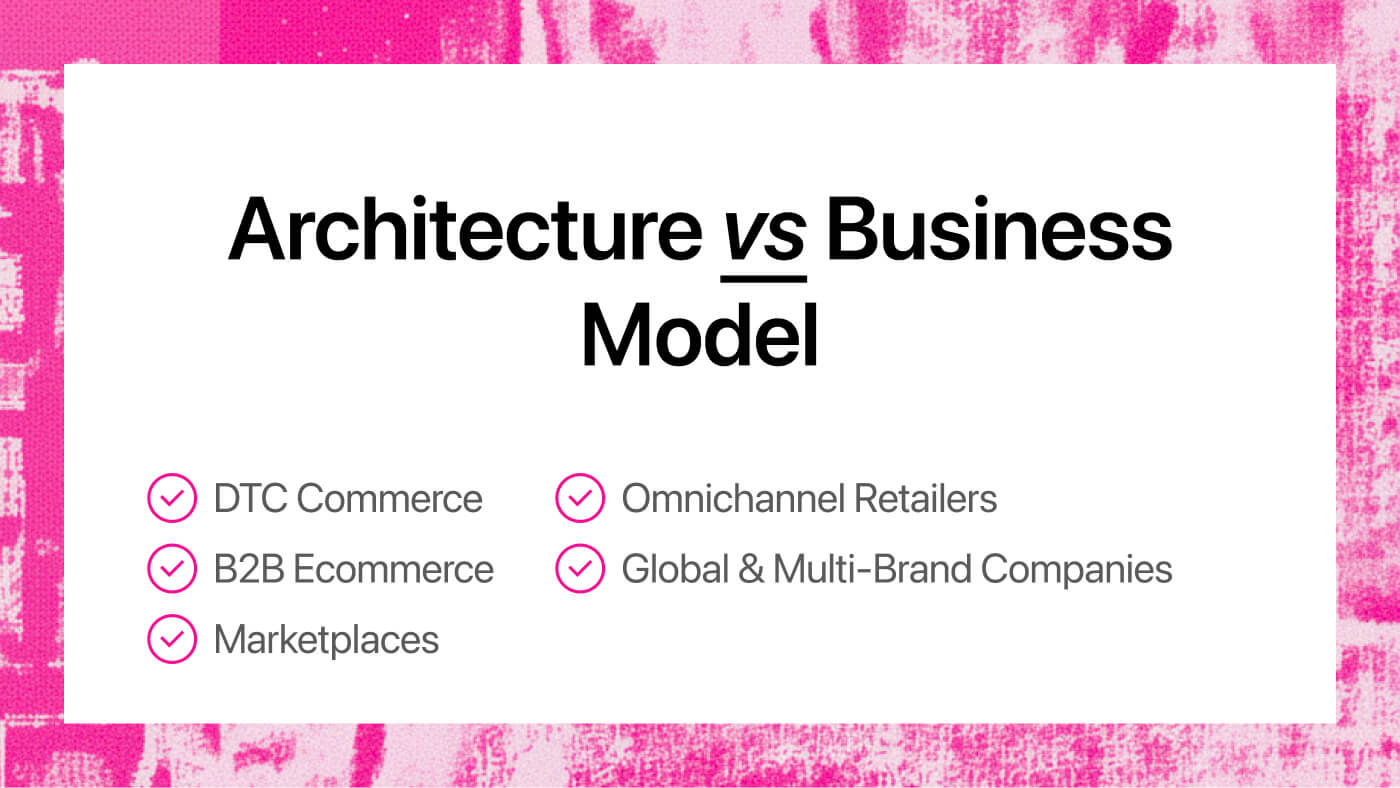
Different business models require different ecommerce architectures. The choice affects everything from operational complexity to the speed of new-feature deployment.
Direct-to-Consumer (DTC) ecommerce is highly dependent on modern ecommerce architecture to deliver personalized, fast, and engaging experiences.
B2B ecommerce works on a business-to-business basis and requires additional complexity.
A B2B industrial supplier implemented a composable architecture to integrate pricing tiers and approvals with SAP ERP. The result: 35% faster order processing and fewer errors.
Marketplaces are online platforms where multiple vendors sell their products under one umbrella. Examples include Amazon, Etsy, and others.
Omnichannel retail integrates multiple customer touchpoints—physical stores, online stores, mobile apps, social commerce, marketplaces—into a seamless shopping experience. For omnichannel businesses, modern ecommerce architecture becomes a true competitive necessity.
Global and multi-brand companies operate across regions, languages, currencies, and regulatory environments.
✅ Best fit, ⚪ Medium fit, ❌ Not recommended
Selecting your best-fitting ecommerce architecture is one of the most critical decisions for an online business. A mismatch can slow your growth and even act as a stopper to your income.
Start by clarifying what your business needs today and in the next 3–5 years:
We recommend creating a requirement matrix mapping each business need to the architecture capabilities. This approach helps you objectively compare monolithic, modular, headless, composable, microservices, and custom architectures.
Before committing fully:
If you lack in-house expertise, the smart course of action would be to seek professional assistance. For example, we at Laconica have a long history in the eCommerce market, during which we've delivered and supported many complex online stores, including enterprise-level ones.
Our team doesn't operate blindly; rather, we analyze your real conditions and needs and combine your business goals, budget constraints, and growth projections with a technical audit. Only on this basis will our experts select the best architectural fit for your project.
Specializing in Magento 2 development for enterprises, we understand the eCommerce architecture required by large companies with complex workflows.
Even the most carefully chosen ecommerce architecture may need updates over time. Businesses evolve, traffic grows, markets shift, and technology advances.
Replatform when you see:
You can choose between big-bang replatforms and incremental modernization, depending on your risk tolerance and business needs.

Each mistake delays revenue capture and increases rework costs. And it is an expert like Laconica who can help you avoid such miscalculations and ensure a successful start.
Our team helps businesses select and implement modern ecommerce architecture:
Ecommerce architecture is the structure of software, systems, and integrations that power an online store, including the backend, frontend, databases, and third-party services.
A well-designed ecommerce architecture ensures fast page loads, reliable checkout, seamless integrations with ERP or CRM, and flexibility for growth. Modern platforms may use headless, composable, or microservices architectures to decouple services, allowing faster innovation and easier updates.
Modern ecommerce architecture is an approach that uses headless, composable, or microservices designs to maximize flexibility, scalability, and speed of innovation.
Unlike traditional monolithic systems, modern ecommerce architecture separates frontend and backend, uses APIs to integrate services, and allows independent scaling of features. This makes it ideal for omnichannel, multi-brand, global, or complex B2B operations.
Choose based on business model, scale, growth plans, integration needs, and innovation speed:
Modular architecture splits a platform into modules within the same system, while microservices architecture creates fully independent services with separate databases and deployment pipelines.
Microservices provide full decoupling, and modular systems are platform-bound but simpler to manage.
Revisit whenever performance issues, scalability limits, integration challenges, or innovation bottlenecks arise:
It depends on requirements, budget, and desired flexibility:
Composing solutions often balances flexibility, cost, and speed, while build or buy is better for specialized or simple use cases.
Yes. By improving speed, reliability, scalability, and personalization, modern architecture directly impacts conversion rates, customer retention, and operational efficiency:
Investing in modern ecommerce architecture is an investment in both customer experience and revenue growth.
Choosing the right ecommerce architecture is your strategic investment that influences revenue potential, competitive agility, and long-term growth. Whether you’re evaluating monolithic platforms, headless solutions, composable stacks, or custom builds, the key is aligning architecture with business goals, customer expectations, and future opportunities.
Business leaders who take a thoughtful, data-informed approach will unlock faster innovation, improved experiences, and revenue acceleration—while avoiding costly rework.
If you need help navigating these choices, consider an architecture audit or strategy session with experienced developers who specialize in creating future-ready eCommerce systems.
Our experts at Laconica are happy to help you with this crucial decision and provide well-founded professional advice. Contact us without further delay!

Written by:
Co-founder / CEO, Laconica
Volodymyr co-founded Laconica in 2014 after seven years as a UI/UX designer for global brands. Since then he has led 100+ Magento and Shopify projects, from migrations to AI visibility and CRO. He writes about what actually moves revenue for online stores, based on client work, not theory.

Reviewed by:
Co-founder / CTO, Laconica
Anna reviews every article on this blog for technical accuracy before it goes live. She has 20 years in software engineering, 15 of them in Magento and eCommerce. Before Laconica she was a C# developer and team lead at large enterprise companies. As CTO she leads the engineering team and oversees Magento 2, Hyvä and Shopify architecture on every client project. If a number or a code claim is in the article, she has checked it.