AI Visual Search
7 minutes read
AI is rapidly expanding its influence worldwide, including its impact on online retail. One of the latest trending e-commerce features is AI-powered visual search. It's really popular among customers, and here is why.
Imagine a shopper browsing a café and spotting a stylish armchair. They love it and want to find it online. They try to type a description: “modern gray armchair, wooden legs, fabric upholstery.” Hundreds of search results appear—many irrelevant. It leads to frustration mounting, interest fading, and ultimately affects sales.
Now, picture a different scenario. The customer snaps a photo and uploads it to your store. Within seconds, the system displays visually similar products, highlights complementary items, and offers price options. It even allows AR placement in the shopper’s living room. This is the promise of AI visual search: bridging inspiration and purchase.
At Laconica, we help e-commerce businesses integrate AR, mobile-first experiences, and AI in visual search, ensuring that moments of curiosity transform into actual sales. And we are ready to share our experience with you so that you know where to start.
Traditional keyword searches require shoppers to know the right words, such as color, style, brand name, or product category. However, sometimes this is simply impossible, as many customers are inspired by what they see. They may browse social media, notice something appealing, but not know how to describe it. They’re trying to type “navy blue mid-century Scandinavian armchair with wooden legs” but that leads to no proper results. The reason is that for many categories — such as fashion, furniture, décor, and accessories — visual attributes matter more than names or technical descriptions.
That’s why lots of purchase intent gets wasted: a shopper might see something they like, but can’t find it in the store because they can’t describe it well. That’s lost revenue and a lost opportunity for conversion.
Visual search with AI capabilities removes the barrier of language or description. Now, customers don't need to be verbal; they just need to demonstrate what they want, and the desired result won't be long in coming.
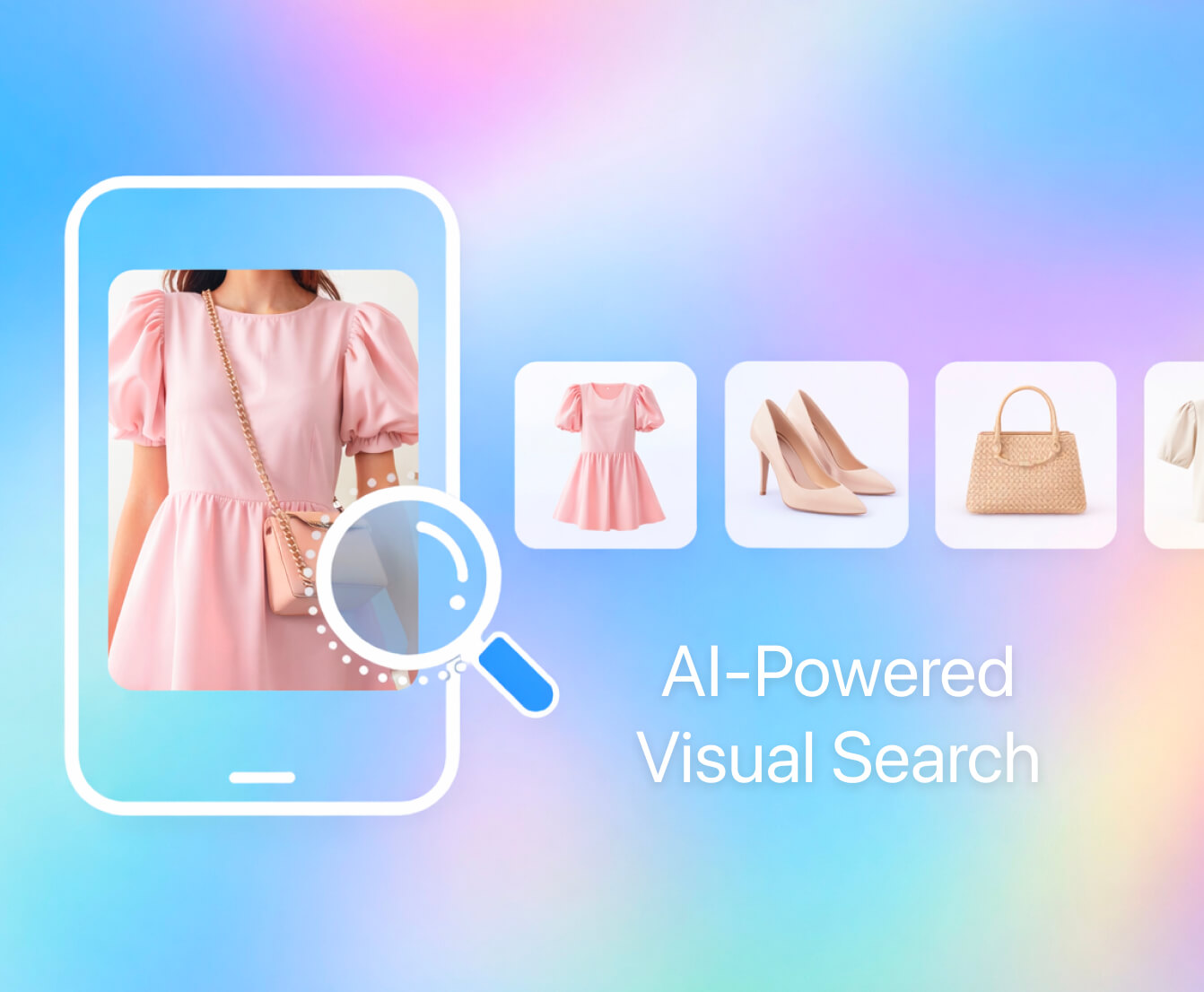
The system with visual search analyzes the uploaded photo, identifies key objects, interprets style, and matches them with catalog items.
Of course, AI plays a key role here, as it's responsible for analysis and even reasoning in a near-human-like manner. Let's take a look under the hood of this technology to understand why we need AI in visual search.
The technologies behind this feature have evolved rapidly, encompassing a wide range of areas, including advanced machine learning, computer vision, and in-depth semantic analysis. Such a tech stack equips the system with the ability to understand images the way humans do—but faster and at scale.
Moreover, the tech progress doesn’t stop here: modern vision-language models and embedding-based retrieval solutions make matching far more semantically deep than old pixel-by-pixel or exact-match methods. For example, a recent study that deployed a zero-shot model in a two-sided marketplace achieved a 40.9% increase in transaction rate via image search compared to the baseline.
But let’s put AI visual search in simpler terms. Essentially, this system is based on image recognition.
Image recognition is directly tied to artificial intelligence, training digital systems to "see" and "understand" pictures and even videos. Visual search, in turn, is a practical application of this technology.
Key capabilities of image recognition include:
Example from our experience: A furniture retailer implemented AI visual search to detect room elements. Customers who uploaded images were 35% more likely to engage with recommended products, and cross-sells accounted for 20% of incremental revenue.
Before we proceed, let's compare traditional catalog browsing, social shopping, and AI in visual search.
Traditional search relies on textual descriptions, which often fail when shoppers can’t articulate style or materials. Social shopping inspires, but it's only the first step toward making an actual purchase (although this method also has a great many benefits, which we discuss in detail in our article). AI visual search, however, bridges the gap, enabling instant discovery, visual matching, and AI-driven personalized recommendations that increase conversions.
By now, you should have a good understanding of the value and significance of the visual search feature. But let's bolster your confidence with some real-world evidence from recent statistics:
While AI is certainly a key element in this scheme, it's far from the only technology worth considering to further improve your customers’ online shopping experience. After all, a satisfied customer is more likely to make a purchase, which directly impacts your revenue.
Let’s start with augmented reality (AR)—a technology that lets customers experience a product before they buy it, in conditions that closely mirror real life. By offering this, you show that you genuinely value your customers’ needs and go beyond simply helping them find a product through visual search. You empower them to make confident decisions, ensuring the product truly fits their expectations before they commit to a purchase.
The power of the AR-enabled AI search:
For certain types of businesses, adopting AI-powered visual search alongside AR-enabled shopping experiences can fundamentally change how customers discover and purchase products—making the journey faster, more intuitive, and more rewarding. For example:
A compelling data point: after a home décor retailer integrated AR with AI visual search, shoppers using the combined experience spent 50% more time browsing and were 30% more likely to make a purchase.
Given that over 70% of e-commerce traffic comes from smartphones (Statista, 2025), it's time to consider a mobile-first shopping experience—if you haven't already. We suggest adding AI-powered visual search, thereby turning your customers' mobile devices into instant product discovery tools:
Example from our experience: A fashion retailer implemented mobile AI visual search, and within approximately three months, saw 35% higher mobile conversions and 22% fewer returns.
Let’s take a quick look at why these technologies work best together. When AR and visual search converge on mobile, they go beyond meeting user needs and start anticipating them.
Major gains in numbers:
Surely, implementing all these features is hardly a piece of cake. There are real challenges — but they can be handled with a capable technical partner:
As you can see, while we see the significant role of AR and AI in visual search, implementing these features in practice isn't all that simple. The solution lies in partnering with a reliable tech team such as Laconica.
As seasoned e-commerce software developers with deep experience on platforms like Magento, Shopify, Hyvä, or custom builds, we deliver:
By partnering with Laconica, you avoid common missteps and get a turnkey path to next-generation product discovery. We handle the full integration cycle, combining AI expertise, AR experience, and mobile optimization. Our goal is to equip your store with AI-powered visual search for maximum ROI.
To learn more about our ecommerce development services and engineering expertise, please visit our homepage.
Yes. Retailers report 20–30% higher conversions. By providing contextually and visually relevant results, shoppers find what they want faster, leading to quicker decisions. For instance, fashion stores see higher cross-selling rates when AI visual search highlights complementary items.
Yes, AI in visual search is compatible with mobile, web, and PWAs. Combined with AR, it enables customers to try on or place items virtually, boosting confidence and reducing returns. Mobile-first integration is crucial for capturing over 70% of global e-commerce traffic.
Fashion, furniture, home décor, beauty, and accessories benefit most, as these rely heavily on visuals. AI-powered visual search helps shoppers find products that are stylistically relevant, increasing engagement and sales.
MVPs can launch in 4–8 weeks, with AR and advanced recommendations layered in 4–12 additional weeks. The exact timeline depends on catalog size, platform, and customization requirements.
Returns typically decrease 20–40% because shoppers can see products in context with AR or find items that match their expectations. This reduces dissatisfaction and improves loyalty.
Shoppers now decide based on visuals, not keywords. AI-powered visual search, enhanced by AR and mobile-first design, reduces friction, increases engagement, and drives revenue.
With Laconica, retailers implement scalable, personalized, high-converting AI visual commerce solutions, transforming inspiration into purchases while improving ROI, AOV, and customer loyalty. And if you’re ready to join their ranks, contact our team immediately.

Written by:
Co-founder / CEO, Laconica
Volodymyr co-founded Laconica in 2014 after seven years as a UI/UX designer for global brands. Since then he has led 100+ Magento and Shopify projects, from migrations to AI visibility and CRO. He writes about what actually moves revenue for online stores, based on client work, not theory.

Reviewed by:
Co-founder / CTO, Laconica
Anna reviews every article on this blog for technical accuracy before it goes live. She has 20 years in software engineering, 15 of them in Magento and eCommerce. Before Laconica she was a C# developer and team lead at large enterprise companies. As CTO she leads the engineering team and oversees Magento 2, Hyvä and Shopify architecture on every client project. If a number or a code claim is in the article, she has checked it.